


Misalignment Isn’t Just an Internal Problem—It’s a Business Problem
Imagine trying to build a bridge, but the architects, engineers, and construction teams never speaking to each other. It would be a disaster waiting to happen.
Now, replace that bridge with your customer experience.
Alignment isn’t an accident—it’s by design. Just like great products require intentional design, so do great organizations. When teams operate in silos, inefficiencies and miscommunications pile up like bad UX—frustrating both employees and customers.
And the cost? It’s bigger than you think.
The Financial Toll of Silos:
- Disengaged employees cost the global economy $8.8 trillion in lost productivity—equivalent to 9% of global GDP. (Gallup, State of the Global Workplace: 2023 Report)
- Misalignment costs businesses between 20-30% of their annual revenue.
- (Forbes, State of the Global Workplace: 2023 Report)
When teams operate in silos, companies create fragmented, frustrating, and costly experiences—both internally and externally. And while misalignment might seem like an internal operations issue, let’s be real: it directly hits the bottom line.
Silos Are Expensive—Here’s How They Quietly Drain Businesses:
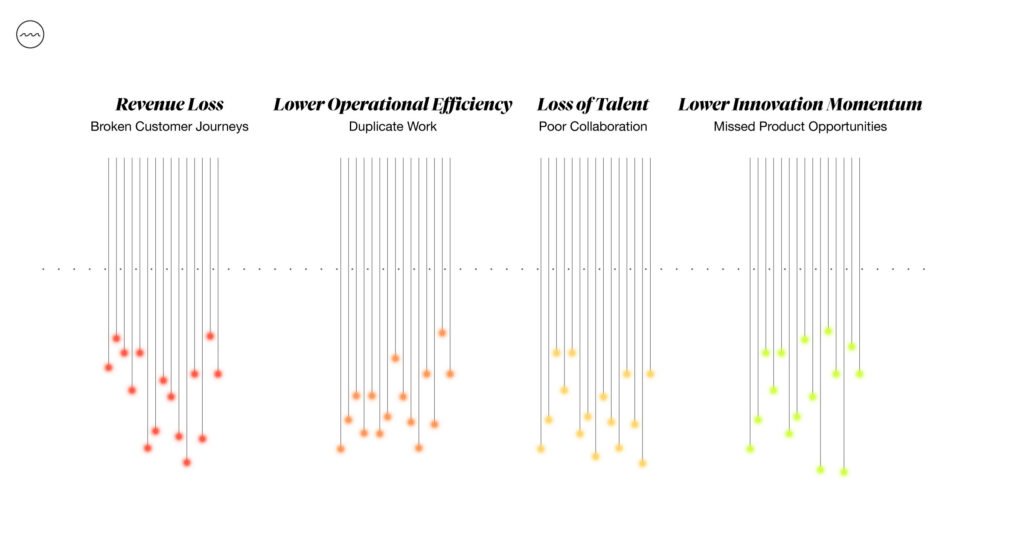
- Revenue Loss → Broken customer journeys mean missed conversions and churn.
- Operational Waste → Redundant work and inefficiencies cost time (and lots of money).
- Talent Drain → Employees disengage when teams don’t collaborate, leading to higher turnover.
- Missed Innovation → When the right people aren’t in the room, game-changing ideas never see the light of day.
Lesson:
A brand isn’t what you say—it’s what your customers experience.
Why Organizational Silos Are Quietly Costing You Millions
Imagine running a company where departments function like isolated islands—finance doesn’t talk to operations, marketing isn’t aligned with sales, and customer experience is an afterthought. Sounds chaotic, right? Unfortunately, this is the reality for many businesses, and the cost of misalignment is staggering.
Silos Are a Multi-Million Dollar Problem
Organizational silos don’t just create inefficiencies—they quietly drain revenue, stifle innovation, and increase operational waste. And the numbers back it up:
- $8.9 trillion in economic losses: A 2023 study found that misalignment between HR and broader business initiatives contributes to nearly 9% of the global GDP in lost productivity. (WorkLife, The high cost of silos: Trillions lost when HR, company goals are out of sync)
- Financial shortfalls: Companies with siloed finance teams face late payments, increased financing costs, and missed savings opportunities.4
- Wasted resources: Employees in siloed organizations spend up to 20% of their time searching for information they can’t access.5
And it’s not just about lost revenue—silos make companies vulnerable to reputation-damaging failures.
Case Study: Wells Fargo’s Billion-Dollar Silo Problem
Even some of the biggest companies fall victim to silos—and the consequences can be catastrophic.
In 2016, Wells Fargo’s sales teams were pressured to meet aggressive growth targets without proper oversight from compliance or leadership. The result? Employees created millions of unauthorized accounts to hit their quotas. (The New York Times, Wells Fargo Fined $185 Million for Fraudulently Opening Accounts)
What Went Wrong?
- Leadership failed to spot warning signs due to broken internal communication.
The Fix:
After the scandal, Wells Fargo had to rebuild trust by restructuring leadership, increasing transparency, and implementing cross-functional oversight teams to ensure ethical business practices.
Lesson: A Brand Isn’t What You Say—It’s What Your Customers Experience
Silos don’t just hurt internal operations—they create frustrating, disjointed experiences for customers. When your teams aren’t aligned, the customer journey becomes inconsistent, leading to churn, negative reviews, and lost revenue.
Key Takeaways:
- Silos increase operational costs through redundant work and inefficiencies.
- Misalignment between departments leads to missed opportunities for innovation and higher employee turnover.
- Cross-functional collaboration isn’t optional—it’s essential for long-term success.
The best companies don’t wait for misalignment to cause damage—they actively design for alignment.
Looking for Inspiration? Here are Some Manifestos We Love.
At Na-Mii, we don’t just fix silos—we design for flow. We believe alignment isn’t an afterthought—it’s the foundation of great companies.
Other Manifestos We Love:
Atlassian – “We believe in open work. Transparency fuels trust, and trust drives results.”
- Break down bureaucracy—Because red tape kills creativity.
- Move fast, but with purpose—Speed means nothing without direction.
- Work together—No lone geniuses, no silos, just people solving real problems.
Netflix – “We believe informed, aligned people make the best decisions.”
- Radical collaboration—Great ideas don’t come from silos.
- Trust and ownership—No micromanagement, no politics, just autonomy.
- Break what’s broken—If a system is slowing us down, we fix it.
Key Takeaways
- Silos cost money, customers, and innovation.
- Misalignment is a design problem—the best companies don’t leave it to chance.
- Alignment isn’t a one-time fix—it’s an ongoing system.
A Fragmented Vision = A Fragmented Customer Experience

The most successful companies don’t just talk about alignment—they design for it. When teams move in sync, ideas flow, collaboration happens naturally, and customers experience seamless interactions. Alternatively, when alignment is missing, friction builds, execution slows, and customers feel the disconnect.
And here’s the cost of that misalignment:
- Customer Abandonment: 17% of U.S. consumers and 32% of global consumers will leave a brand after just one bad experience.9
- Loss of Trust: 86% of consumers say they will leave a brand they previously trusted after just two poor experiences.10
- Revenue Left on the Table: 86% of buyers say they’re willing to pay more for a great customer experience—yet only 1 in 3 companies actually deliver it.11
When departments like marketing, product, sales, and customer success don’t share a single vision, customers feel it—and they leave.
Case Study: Uber’s 2016 Rebrand—A Lesson in Disconnect
In 2016, Uber unveiled a bold new rebrand—without consulting customers. The company shifted from its recognizable “U” logo to an abstract geometric shape.
The Problem
- Users didn’t recognize the new branding, leading to confusion.
- The design shift wasn’t user-tested, resulting in frustration and usability issues.
- Internally, employees were caught off guard by the change, lacking a unified story to tell customers.
The Cost of Misalignment
- Public backlash and brand disconnect
- Lower user engagement due to a lack of familiarity
- Millions spent reworking brand identity and customer communications
The Fix:
When Uber revisited its branding strategy in 2018, it returned to a simpler, more recognizable design—this time, aligning internal teams and gathering user insights before launching changes.
Key Takeaways: Designing for Alignment
- Internal Alignment = External Clarity. If your team isn’t aligned on brand identity, your customers won’t be either.
- User-Centered Design First. Your brand isn’t what you say it is—it’s what your customers experience.
- Collaboration Prevents Costly Mistakes. The best brands design with users, not for them.
Misalignment isn’t just an internal inconvenience—it’s a direct threat to revenue and customer trust. The brands that thrive are the ones that build seamless experiences from the inside out.
The Best Companies Involve Everyone in KPIs
If you want real alignment, don’t just set KPIs at the top and expect teams to buy in. True alignment happens when every department has a seat at the table and a say in what success looks like.
The Data Backs It Up:
- Organizations with highly engaged employees see 23% higher profitability and 10% higher customer loyalty. (Gallup, State of the Global Workplace: 2023 Report)
- Companies that co-create KPIs with employees experience a 25% boost in engagement and a 30% reduction in failed product launches.14
- Employees who feel heard are 4.6x more likely to perform their best work. (Salesforce – How Engaged Employees Are the Path to Success)
The Fix:
KPIs shouldn’t just be top-down directives. When teams actively participate in defining their own success metrics, alignment becomes natural, not forced.
The Lesson:
When people help define success, they take ownership of it. Alignment isn’t about dictating—it’s about designing the right structure for teams to thrive.
Investing in Alignment Saves More Than It Costs

The Cost of Silos: Frustrated customers, disengaged employees, lost revenue.
The ROI of Alignment: Stronger teams, smarter decisions, seamless experiences.
And here’s the kicker: fixing misalignment costs WAY more than preventing it.
The Business Case for Investing in Alignment & Employee Experience
Companies that prioritize internal alignment and employee experience outperform those that don’t:
- 4.2x higher profit and 2.8x higher revenue per employee (MIT Center for Information Systems Research (CISR), Building Business Value with Employee Experience)
- 208% more revenue from marketing efforts when sales & marketing teams are aligned (LinkedIn B2B Institute, Quantifying the Misalignment of B2B Marketing and Sales)
- 41% reduction in absenteeism and 17% increase in productivity in highly engaged business units (Gallup, How Employee Experience Impacts Organizational Health)
But beware: Alignment isn’t just about throwing in new tools or scheduling more meetings—without proper change management, it can backfire. We’ll dive into best practices for that in a future article.
Case Study: Philips’ Transformation Through Organizational Alignment
In 2024, Philips faced significant challenges due to a massive recall of its CPAP and ventilator machines, which posed potential health risks. Roy Jakobs, appointed as CEO amid this crisis, initiated a comprehensive restructuring plan to realign the company’s focus and operations.
Key Actions Taken
- Simplified Organizational Structure: Transitioned from a complex matrix model to a more straightforward divisional structure, granting each business segment full profit and loss accountability. This change aimed to enhance agility and decision-making.
- Enhanced Employee Engagement: Engaged employees by seeking their input on organizational improvements, leading to clearer accountability and faster decision-making processes.
Outcomes
- Increased Employee Engagement: The company observed an 8% rise in employee engagement within a year, reaching a score of 78%, close to the global norm of 80%.
- Operational Efficiency: The restructuring led to a leaner organization with reduced handover points, enhancing agility and efficiency.
- Financial Performance: The company returned to growth, with improved margins and profitability, indicating the positive financial impact of the alignment efforts.
Final Thought: The Business Case for Flow

Alignment isn’t about more meetings. It’s about momentum.
Teams stuck in silos slow down. They redo work. They miss signals. And they waste time fixing problems that shouldn’t have existed in the first place.
But companies that move in flow? They win.
- Flow creates speed without chaos.
- Flow removes friction and fuels innovation.
- Flow isn’t just culture—it’s a competitive advantage.
The ROI of Flow
Companies that master cross-functional collaboration don’t just work better—they win faster.
- They innovate 2.5x faster than their competitors. (Forrester, Aligning Around The Customer Will Turbocharge Companies’ Growth Engines)
- Companies that prioritize cross-functional collaboration experience 36% higher customer retention than those that don’t. (Forrester Research, “The Power of Alignment: Why Customer-Obsessed Companies Grow Faster)
- Companies that adopt a customer-obsessed technology strategy report 2.5 times greater revenue growth. (Forrester Research, Customer-Obsessed Companies Achieve 2.5x Greater Revenues)
The Na-Mii Difference: We Design Flow
At Na-Mii, we don’t just break down silos—we engineer the structures, workflows, and alignment strategies that keep businesses in motion.
Because alignment isn’t luck. It’s designed.
Ready to Remove Friction and Move Faster?
Big ideas.
Smart strategy.
Zero overwhelm.
Sign up for the good stuff.


